2025
Empire Workshop, 17-18 October 2025.

The EMPIRE project hosted a two-day workshop at Trinity College Dublin’s Long Room Hub on 17–18 October 2025, bringing together colleagues from Trinity and invited scholars from across Europe and North America to discuss Ireland’s place in the making of the early modern Atlantic world. The workshop explored the project’s central claim: that Cromwellian Ireland was not merely a peripheral colony, but a crucial source of land, finance, food, and administrative practice for England’s later imperial expansion.
The first day focused on the Research Ireland-funded EMPIRE project, with presentations on the project’s aims, the use of AI and digital humanities in historical research, the role of confiscated Irish land in financing Atlantic ventures, and the importance of Irish beef in sustaining the Caribbean plantation complex. The second day looked ahead to a prospective ERC project on comparative empires, examining how a concordance of sources from European archives might enable a broader study of colonial governance across the different European imperial systems. The discussions highlighted Ireland’s centrality to empire and the potential of new digital methods to transform seventeenth-century historical research. Contributors used the forum to test research questions, refine methods, and identify future collaborations.
Conference Presentation: Empires: Experience, Memory and Ideas. Navarra, Spain, October 1 2025.
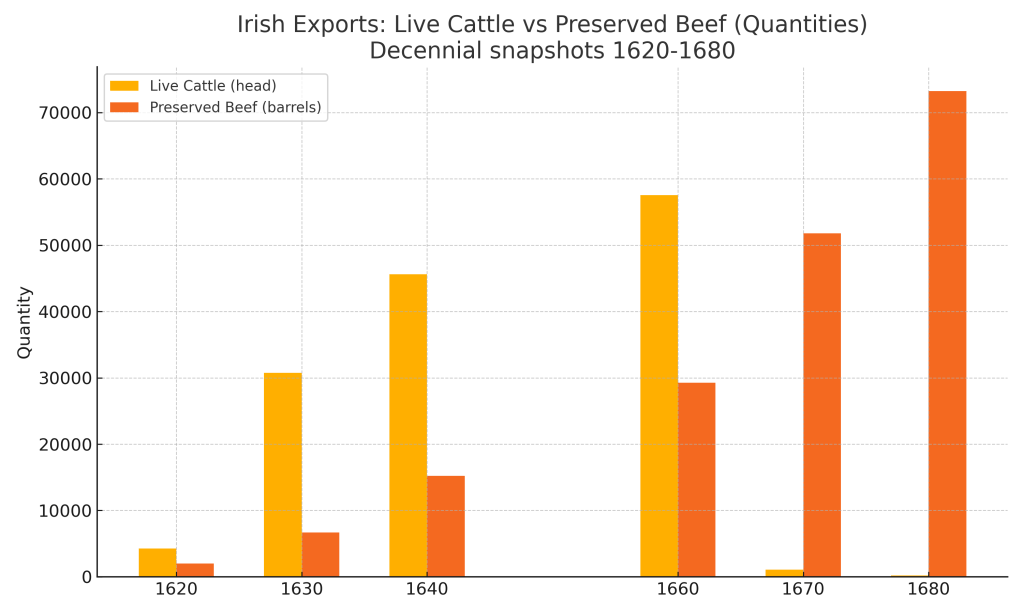
“Provisioning Empire: Irish Beef and the Memory of Atlantic Imperialism”
While history primarily studies the human past through political, social, and cultural narratives, specific aspects such as trade frequently remain overlooked or marginalized. This paper addresses this gap by examining the seventeenth-century Irish beef and cattle trade as a crucial yet underappreciated dimension of imperial experience, memory, and ideology in the Atlantic world. The enactment of England’s restrictive Cattle Acts beginning in 1667 inadvertently compelled Irish merchants and colonists to innovate, shifting from exporting live cattle to preserved beef, tallow, and hides. This transformation integrated Ireland deeply into transatlantic supply chains that were essential to sustaining enslaved populations in Caribbean colonies, particularly in Barbados and the French Antilles.
Drawing on archival materials, customs returns, and mercantile records, this study reveals how expelled Irish merchants capitalized on continental exile in French Atlantic ports such as Nantes and La Rochelle, using intricate networks to bypass English mercantilist restrictions. Concurrently, English settlers newly established in Ireland developed parallel provision routes linking Irish agricultural productivity directly to Caribbean plantations, embedding Ireland’s economy within imperial and racialized structures of exploitation.
By highlighting provisioning as a significant yet often neglected element, this paper contributes to contemporary scholarly discussions surrounding empire, memory, and identity. It interrogates how the overlooked history of Irish beef provisioning provides new insights into the processes by which imperial power was sustained economically and ideologically.
UK Parliamentary Archives Workshop – Westminster(Portcullis House), June 2025
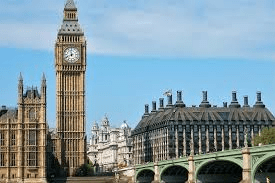
The UK Parliamentary Archives, part of Parliament’s Information Services, preserves and provides access to the records of both Houses and supports public engagement with Parliament’s documentary heritage. At a 2025 workshop hosted by the Parliamentary Archive at Westminster (Portcullis House), Dr David Brown explored how AI can help open the seventeenth-century Commons and Lords Journals to new forms of historical research. The emphasis moved beyond transcription and cataloging to connectivity: turning parliamentary proceedings into linked data for biography, geography and political history, while strengthening the discoverability of one of Britain’s major archives.
Symposium: Universität des Saarlandes, Saarbrücken, 26-28 February 2025
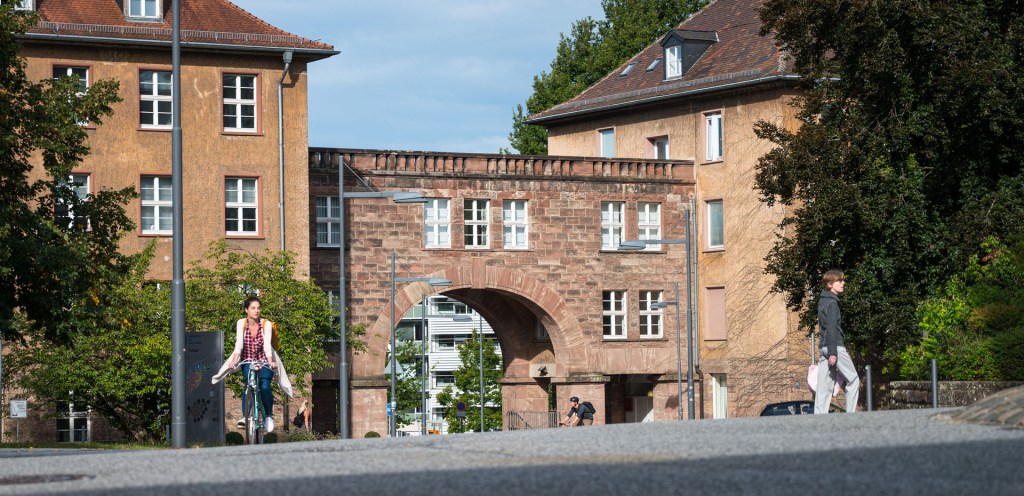
In February 2025, the Universität des Saarlandes, Saarbrücken, hosted a symposium entitled ‘Irish Studies in a Changing Europe’, attended by the Irish ambassador to Germany and the mayor of Saarbrücken, as well as a host of academics working the field of Irish Studies from across Europe, including Germany, the Netherlands, France, Ireland and the UK. Professor Micheál Ó Siochrú delivered one of the keynote lectures at the symposium, entitled ‘Lost’ Sources and the Reimagining Early Modern Irish History’. A version of this lecture, written in Irish, will appear in an edited volume, published by the Universität des Saarlandes, based on the symposium. Link to abstract

